
Commissioners say local vendors should get the chance to bid instead of the county defaulting to statewide contracts.
By Linda Dean Cooper
What should have been a routine agenda item — approving the purchase of a replacement pickup truck — quickly exposed a deeper frustration from two county commissioners: how Levy County buys equipment and whether local businesses are ever given the chance to compete.
Solid Waste asked the Board of County Commissioners to approve the purchase of a 2026 Ford F-150 crew cab for $48,066 through the Florida Sheriff’s Association purchasing contract.
The truck will replace a 2002 vehicle with nearly 300,000 miles that had been used to haul the county’s recycling trailer. No one disputed that the truck needed replacing.
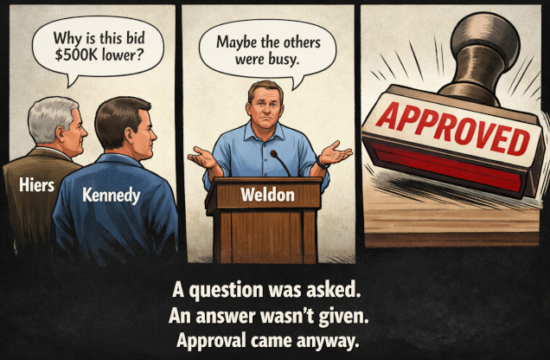
But for Commissioners Johnny Hiers and Charlie Kennedy, the issue wasn’t the truck. It was the process.
And for local vendors in Levy County, that process may determine whether they ever get a chance to compete.
“It’s Been a Year”
Hiers made it clear that the concern had already been raised with administration multiple times. “I’ve gone over that with Mary Ellen,” Hiers said, referring to County Manager Mary Ellen Harper. “I’ve asked several times, and it keeps coming back that we’re working on it.”
Then came the line that captured the room.
“It’s been a year.”
Hiers and Kennedy say the issue is simple: local vendors are not even being given the opportunity to bid.
“If the Sheriff’s bid is the best deal, then fine,” Hiers said. “But our local businesses should at least get the opportunity.”
“Our Hands Are Tied”
Fleet Division Director Jessie Robinson, who oversees vehicle acquisition for county departments, explained that the county typically relies on the Florida Sheriff’s Association contract because the competitive bidding has already been completed at the state level.
Robinson said departments often rely on those cooperative contracts unless the county issues its own Request for Proposals.
Issuing a full RFP, he noted, can take months. In short, Robinson indicated staff’s hands are largely tied by the way the policy is written. That explanation did little to ease the concern from Hiers and Kennedy.
Their question was straightforward:
Is the policy really the problem — or has using the Sheriff’s contract simply become the easiest path?
“We need to support our local vendors as much as we can,” Hiers said.
A Management Question
Cooperative purchasing contracts are legal and commonly used by governments. But Tuesday’s exchange suggested the issue may not be the procurement policy itself. The county’s rules already allow multiple purchasing paths, including issuing competitive bids or Requests for Proposals.
The Sheriff’s contract is simply one option. For Hiers and Kennedy – the concern appears to be how the policy is being applied – the policy says.
If local vendors never get the opportunity to compete – commissioners argued – the result is the same, regardless of what the policy allows.
Chain of Command
Under the county’s organizational structure, vehicle acquisition falls under the Fleet Division, which secures vehicles and equipment for county departments.
Administrative oversight of purchasing practices ultimately rests with the County Manager’s office, responsible for ensuring departments follow the direction of the Board.
That is why Hiers’ comment about raising the issue with Harper carried weight.
The concern had already moved through the administrative chain of command.
Yet the same purchasing approach continues to appear on the commission agenda.
Budget and Planning Questions
Robinson noted that issuing a competitive bid can take months. But the timeline raises a reasonable budget and planning question.
The vehicle being replaced is a 2002 truck with nearly 300,000 miles, equipment that has clearly been approaching the end of its service life for years.
If the county has a fleet replacement schedule or justification form, commissioners and the public should be able to see it. That information was not included in the agenda materials or presentation.
A truck with nearly 300,000 miles does not suddenly appear on the replacement list.
What Happens Next for County Purchasing
By the end of the discussion, staff said revisions to the county’s procurement policy are being drafted. Whether rewriting the policy will address the issue remains to be seen.
The frustration voiced Tuesday suggests a broader concern.
If commissioners have been asking for over a year that local vendors be allowed to compete, the real question may not be the procurement policy at all.
It may be whether county management is following the direction of the Board.
———————-
There are two Spotlight FB pages, one is private, and the other is public@ https://www.facebook.com/groups/3911325592491482
Posted March 5, 2026 | Spotlight on Levy County Government